How Deep are your Roots? VC started and still sets the Standard!
The History of Vacheron Constantin: Why the World's Oldest Watch Brand Still Sets the Standard
There's a reason serious collectors speak about Vacheron Constantin in a different tone than they do most other watch brands. It's quieter. More reverent. When you're holding 270-plus years of uninterrupted watchmaking history on your wrist, bragging feels beside the point.
Vacheron Constantin — VC to those who know — holds a title no other maison can claim: the oldest continuously operating watch manufacturer in the world. Not just old. Continuously operating. Not a single year missed since 1755. That's a record that survived revolutions, world wars, economic collapses, and the quartz crisis. Think about what it takes to keep any enterprise running for nearly three centuries without interruption, and the achievement becomes staggering.
This is that story.
1755: A Watch Brand Is Born in Geneva
The Vacheron Constantin history begins with a 24-year-old watchmaker named Jean-Marc Vacheron, who set up shop in Geneva in 1755. He wasn't trying to build a legacy. He was a craftsman doing what craftsmen do — making things with extraordinary care.
Geneva was already establishing itself as the epicenter of fine horology. The city's strict Calvinist culture had paradoxically created the perfect conditions for watchmaking: intricate, painstaking work that demanded patience and precision, with luxury goods that could be exported rather than worn locally. Vacheron fit perfectly into that tradition.
His first known commission dates to 1755 — a letter to a client confirming an order. It's a small piece of paper, but it's also a timestamp that sets VC apart from every other luxury watch brand on earth. From that moment, the atelier never stopped.
The Partner Who Changed Everything
Jean-Marc Vacheron passed his craft to his son Abraham, and the workshop continued growing quietly through the late 1700s. But the transformation from local Geneva atelier to international maison began with the arrival of François Constantin.
In 1819, Constantin joined the business as a commercial partner — and he brought something the Vacheron family's watchmaking genius had lacked: a relentless hunger for markets. Constantin traveled across Europe and America drumming up business, writing back to Geneva with orders and intelligence about what wealthy clients wanted.
His letters to the workshop contain one of watchmaking's most enduring phrases, which became the company motto: "Do better if possible, and that is always possible."
With that, the brand took its permanent name: Vacheron Constantin.
The partnership crystallized what would define VC for the next two centuries — technical mastery paired with a deep understanding of what discerning collectors actually want.
The Hallmark of Geneva: A Standard Above Standards
In 1901, the Poinçon de Genève — the Hallmark of Geneva, or Geneva Seal — was established as a formal quality certification for watches produced in Geneva. Vacheron Constantin became one of its earliest and most consistent adherents.
To earn the Hallmark of Geneva, every component of a watch movement must meet a set of strict criteria: precision finishing, specific tolerances, and the requirement that the movement actually be assembled within the canton of Geneva. It's the kind of standard that adds hours of hand labor to every single watch.
VC didn't just comply with the Hallmark — they helped define what excellence in Geneva watchmaking should look like. For collectors, a VC movement bearing the Geneva Seal means you're not just buying a watch. You're buying a piece that passed a standard most movements never even attempt.
This is one reason VC watches hold their value in ways that lesser brands simply cannot match. Provenance and craft are baked into every piece at a foundational level.
The 20th Century: Mastering Complications
By the early 1900s, Vacheron Constantin's reputation for complications was firmly established — and it was about to be tested at the highest level.
The American Market and Pocket Watch Excellence
The late 19th and early 20th centuries saw VC cultivate a strong following among American collectors and financiers. The brand produced extraordinary pocket watches with grand complications — perpetual calendars, minute repeaters, tourbillons — that appealed to the era's industrialists and business magnates who wanted their wealth visible in their vest pockets.
These pieces were not just timekeepers. They were engineering demonstrations — proof that human hands could achieve mechanical precision that rivaled any machine of the era.
The Calibre 1003: Thinnest Movement of Its Time
In 1955, VC marked its 200th anniversary by releasing the Calibre 1003 — at the time, the world's thinnest mechanical movement ever made. It measured just 1.64mm thick.
This wasn't just a technical stunt. It was a statement about the direction of VC's design philosophy: ultra-thin, elegant, and restrained. The Calibre 1003 established the blueprint for what would eventually become one of the brand's most celebrated collections.
The Tour de l'Île: A Statement for the Ages
If any single watch defines what VC is capable of, it's the Tour de l'Île, released in 2005 to mark the brand's 250th anniversary. The Tour de l'Île contained 16 complications in a double-faced case — including a perpetual calendar, a minute repeater, a tourbillon, a second time zone, and a sky chart of Geneva. Only seven examples were made.
It remains one of the most complicated wristwatches ever produced. More than a watch, it was a declaration: VC hasn't just survived 250 years. It's still at the frontier.
The Iconic Collections: What Collectors Actually Wear
While grand complications define VC's technical ceiling, three collections define the everyday experience of owning a Vacheron Constantin — and they're what you'll find on the wrists of the world's most thoughtful collectors.
Patrimony: Dress Watchmaking at Its Purest
The Patrimony collection carries the Calibre 1003's DNA into the modern era. Ultra-thin, clean-dialed, and almost aggressively restrained, Patrimony watches are the kind of piece that says everything without saying a word.
The design draws directly from VC's mid-century archive — the signature Maltese cross on the crown, the slim case profile, the minimalist applied hour markers. For collectors who want a watch that works as well with a tuxedo as with a business suit, Patrimony is the answer.
From a value perspective, Patrimony's ultra-thin movements represent some of the most technically demanding watchmaking VC produces. The complication variants — perpetual calendar, complete calendar, power reserve — regularly command significant premiums on the pre-owned market. Well-maintained examples tend to appreciate steadily, particularly full-set pieces with original box and papers.
Overseas: The Sports Watch Refined
The Overseas is VC's answer to the question: what does a luxury sports watch look like when the maker's entire tradition is built on refined elegance?
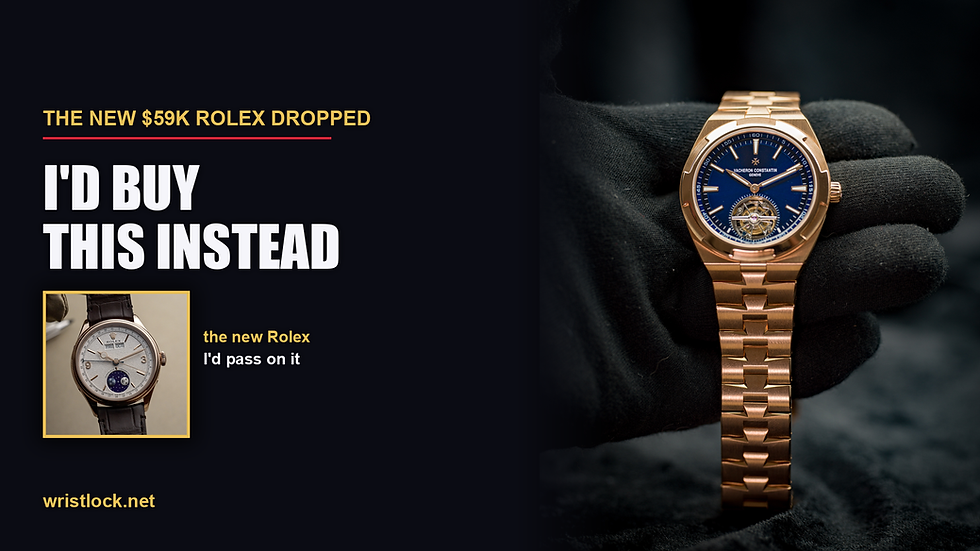
The answer arrived in 1996, when VC launched Overseas with a case design that echoed the Geneva Cross and an integrated bracelet that manages to feel both substantial and precise. It's a sports watch that can handle a weekend on a boat without looking out of place at dinner afterward.
What makes Overseas particularly interesting for collectors is its bracelet system: later generations introduced quick-change straps, allowing the same watch to shift between steel bracelet, leather strap, and rubber strap depending on the occasion. Versatility at this level of finishing is rare.
Pre-owned Overseas watches — particularly chronograph variants and pieces with colored dials — have seen strong demand in recent years. The brand has a smaller production volume than AP or Rolex, which keeps supply constrained and supports values accordingly.
Historiques: When the Archive Becomes the Blueprint
The Historiques collection does something that requires genuine confidence: it looks backward on purpose. VC pulls designs from its 270-year archive, identifies pieces that were ahead of their time, and reissues them with modern movements while keeping the original aesthetic intact.
The American 1921, with its rotated dial designed for drivers who wanted to read the time without lifting their hand from the wheel, is perhaps the most immediately recognizable Historiques piece. The result is a watch that feels genuinely different from anything else in the market — because it's drawing from a well of design history that simply doesn't exist anywhere else.
Historiques pieces attract a specific type of collector: one who wants something that tells a story, not just the time. That narrative premium tends to hold well at resale.
Why VC Watches Hold Their Value
Three factors explain why Vacheron Constantin consistently performs well on the pre-owned market:
1. Genuine scarcity. VC produces roughly 20,000 watches per year — a fraction of Rolex's output. Low production combined with high demand keeps the secondary market healthy.
2. Unbroken provenance. When you buy a VC with full documentation — the Hallmark of Geneva on the movement, original box and papers, warranty card — you're holding something that sits at the apex of a 270-year tradition. That provenance is real and verifiable, and serious buyers pay for it.
3. The collector community. VC attracts buyers who tend to hold their watches longer and care for them more carefully. The result is a healthier inventory of well-maintained pre-owned pieces, and a community of buyers willing to pay for that quality.
For collectors comparing VC to AP or Patek, the key differentiator is often this: VC tends to fly slightly under the radar compared to the Royal Oak or Nautilus hype cycles, which means you can still acquire exceptional pieces at prices that haven't been inflated by speculative demand. That window doesn't stay open forever.
The Modern Era: Richemont and What's Next
Vacheron Constantin became part of the Richemont Group in 1996 — the same conglomerate that houses Cartier, IWC, Jaeger-LeCoultre, and Piaget. The acquisition brought investment and distribution reach without compromising the atelier's creative direction or its Geneva manufacturing base.
Today, VC continues producing movements in-house, continues earning the Hallmark of Geneva, and continues its Métiers d'Art series — watches with dials created through ancient decorative arts like enamel painting, engraving, and guilloché. The Métiers d'Art pieces represent something genuinely different from anything produced elsewhere: wearable art objects with the added merit of extraordinary horology underneath.
The brand also continues pushing its complications program. The 57260 — a pocket watch completed in 2015 after eight years of development — contains 57 complications, the most of any watch ever made. VC built it to celebrate their 260th anniversary. They could have made something comfortable. They made something unprecedented instead.
Find Vacheron Constantin at Wristlock LLC
The Vacheron Constantin brand history is inseparable from what makes these watches so compelling to own: every piece carries the weight of an unbroken legacy and the precision of some of the finest hands in horology.
At Wristlock LLC, we specialize in pre-owned luxury timepieces — and VC is among the brands we're most particular about. Whether you're looking for a clean Patrimony dress watch, a versatile Overseas chronograph, or something from the Historiques archive, we source only pieces we'd be proud to wear ourselves.
Browse our current inventory at wristlock.net — and if you don't see what you're looking for, reach out. We'll source it. That's what we do.
Wristlock LLC — Kenner, LA | wristlock.net | sales@wristlock.net


Comments