Watches Are Getting Smaller. Every Piece I Own Is 40mm or Bigger.
I have a rule about what goes in my safe. If I would not wear it, I do not sell it.
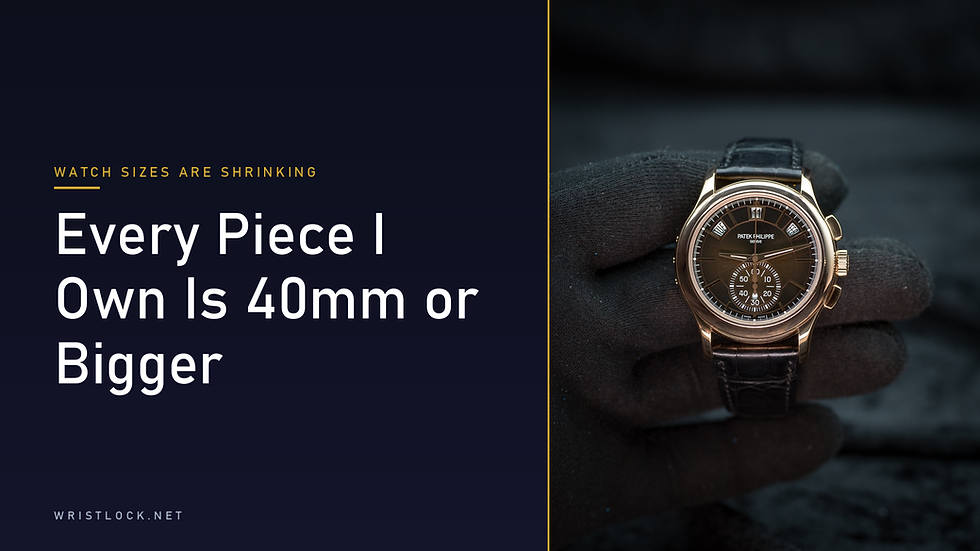
I am a big guy. That rule has a consequence, and the consequence is that there is not one watch in my stock under 40mm. Not a single piece. Never has been, and going by what my clients ask for, it never will be.
The industry has spent about three years now telling everyone the opposite. Small is back, 36 is the number, your 44 is embarrassing. I have read all of it and I have not bought a single one of those watches.
So here is what the size data actually shows, why the brands keep moving the number, and why the guys who call me keep landing on 40 and up anyway.
The shrinking is real. I am not going to pretend it isn't.
Somebody finally counted. Screw Down Crown ran the specs on all 5,957 watches entered into the Grand Prix d'Horlogerie de Genève between 2001 and 2026 and published the analysis in August 2026.
The median round entry measured 43 to 43.5mm in 2008 and 2009. Through most of the 2010s it sat around 42. It hit 41.5mm in 2021 and it has been 40mm for the last three editions.
The sharper number is the tail end. In 2009, 76% of entries measured 42mm or larger. This year that figure is 29%.
That is a real move and anybody arguing it isn't happening is lying to you. But read what the number actually measures. GPHG entries are what brands choose to submit to a competition. It tells you what the industry wants to be seen making. Whether men are buying it and wearing it is a completely separate question, and the two come apart more often than the magazines let on.
Every size trend in history was a sales mechanism
Audemars Piguet put out the Royal Oak in 1972 at 39mm and the trade called it the Jumbo. Not as a joke. Thirty-nine millimeters was so far past what a man was supposed to strap on that the size became the watch's nickname and it stuck for fifty years. Patek did the same thing four years later — the Nautilus 3700/1A landed at 42mm across its widest point and picked up the identical nickname for the identical reason.
Then Sylvester Stallone bought a Panerai Luminor in 1993 and wore his 5218-201/A through Daylight in 1996. Most men's sport watches were 40mm at the time. His was 44. Schwarzenegger noticed, half of Hollywood noticed, and an obscure Italian dive-watch outfit turned into the reason your uncle owns something the size of a coaster.
The brands chased it hard, because a bigger case solved their problems. More room for a display back. More visible finishing. More presence sitting in a boutique case, which is where the buying decision usually gets made.
Now the number is going the other way, and the mechanism is exactly the same one. A man with five watches has no reason to buy a sixth in a size he already owns. Give him a reason. Move the number, run the story, sell him the same watch again 5mm smaller.
Every swing sold a lot of watches. Not one of them had anything to do with your wrist.
Look at what they hold up as proof
Here is the part that should make you suspicious. The two watches the coverage leaned on hardest this year to prove men's watches are shrinking are not men's watches.
Audemars Piguet released two stone-dial Royal Oak Minis at 23mm. Black onyx at $46,000, extra-white mother-of-pearl in yellow gold at $38,400. Twenty-three millimeters, quartz movement, 6.6mm thin, frosted gold, sold in the women's collection. It is a bracelet with a dial on it, and AP has never once pretended otherwise. Filing that under "the sizing trend" as though it tells a grown man what to wear to a closing dinner is either sloppy or deliberate.
Vacheron's small Overseas gets used the same way and it deserves better, because the watch itself is good. The 2026 versions are handsome — burgundy dial in steel, ref 4600V/200A-H127 at $26,600, pink gold ref 4600V/200R-H128 at $59,500. But Vacheron has been building the Overseas at 34.5mm since 2023, so nothing shrank this year. And their own style director describes the size as one "equally suited to both men's and women's wrists." That is a watch aimed at everybody. The Overseas that moves through my hands is the 41.
Meanwhile Richard Mille is still building the RM 011 at 50mm by 40mm by 16.15mm thick. I do not have one client asking whether it comes smaller.
Take the women's pieces out of the story and look at where the men's end actually landed. That GPHG median has been sitting at 40mm for three editions running. The industry shrank all the way down to the bottom shelf of my case and stopped.
What my own rooms say, and the part nobody mentions
I sit in a stack of dealer trading groups and I archive everything that moves through them. Between 6 August 2025 and 8 September 2026, 764 different dealers posted a want-to-buy that named a case size.
541 of them asked for 36mm or under at some point. 484 asked for 40mm or bigger. 297 did both.
On the face of it that looks like a win for small. Then you break it out by brand.
Of the dealers hunting 36mm and under, 389 were chasing a Rolex. That is the whole story of the small end — 31mm and 36mm are Datejust sizes, and the Datejust is the most heavily traded watch on the planet. You already know what I think about Rolex, and I am not going to change my opinion about a brand because a lot of people trade its most common reference.
Look at the brands I actually deal in and it flips. Vacheron: 8 dealers hunting 36mm and under, 44 hunting 40 and up. Patek: 23 small, 39 big. The men buying the watches I sell are buying them big, and they have been the entire time this trend has supposedly been happening.
Two caveats so you can weigh that properly. These are dealer buy requests, not retail sales, so they measure what trades hard rather than what a man buys and keeps. And they describe the pieces moving inside my own archive, one size compared against another within it. I am not claiming to speak for the whole market.
How to make a 40mm and up watch wear right
Buying big well is a skill. Buying big badly is how people end up convinced they need a small watch.
Diameter is the number everybody quotes and it is the least useful one on the list.
Lug-to-lug decides everything. Tip of the top lug to tip of the bottom lug. It determines whether the watch sits on your wrist or hangs off the sides of it. A 42mm case with short curved lugs wears better than a 39mm with straight ones. If the lug-to-lug runs longer than the flat span across the top of your wrist, that piece will never look right on you and no spec sheet fixes it.
Thickness kills more watches than width does. A 41mm case at 9mm slides under a shirt cuff and you forget it is there. That same 41mm at 15mm catches on every sleeve you own and you quietly stop wearing it by month three. The original Royal Oak got away with 39mm in 1972 because it was about 7mm thin. That is the detail people skip when they quote it.
Dial opening is the sleeper. Two watches at the same diameter can read a full size apart depending on how much bezel is eating the face. A thin-bezel 41 wears bigger than a fat-bezel 42 every time.
Measure the flat part across the top of your wrist, not just the circumference. That is the number all three of those depend on. Most men who run 7 inches and up across that flat span wear 40 to 42 perfectly and could go further.
The part where I refuse to tell you it is an investment
Somebody always asks which sizes hold value best. I am not answering that, and anybody who answers it with confidence is guessing. Whatever the chart says this year it will say something else in six, and you will still be the one wearing it.
You built a company. You have wanted a particular watch since you saw it on somebody you looked up to back when you could not afford it. You can afford it now.
Buy that one, in a size that looks like it belongs on your arm, and wear the hell out of it. That is the only reason that still holds up when the market goes sideways, and it is the reason every serious collector I know actually buys.
Try it on if you can. If you cannot, send me the flat width across your wrist and the circumference, tell me what you are hunting, and I will tell you straight whether it works on you — including the times the answer is that the piece you have your eye on is the wrong shape for your arm. You get exactly what I tell you it is. No stories, no games.
Want a piece? DM or call me and I will get you the details.


Comments